The 2025 Audit Revolution: 5 Surprising Shifts That Change Everything for Modern Governance
The Accountability Epoch: Why 2025 is the Point of No Return
The velocity of technological disruption, spearheaded by the relentless integration of Artificial Intelligence, has triggered a global crisis of complexity. For organizations striving to maintain integrity and resilience, the margin for error has vanished. We are no longer navigating a season of incremental change; we have entered a revolution of accountability where traditional oversight models are being rendered obsolete in real-time.
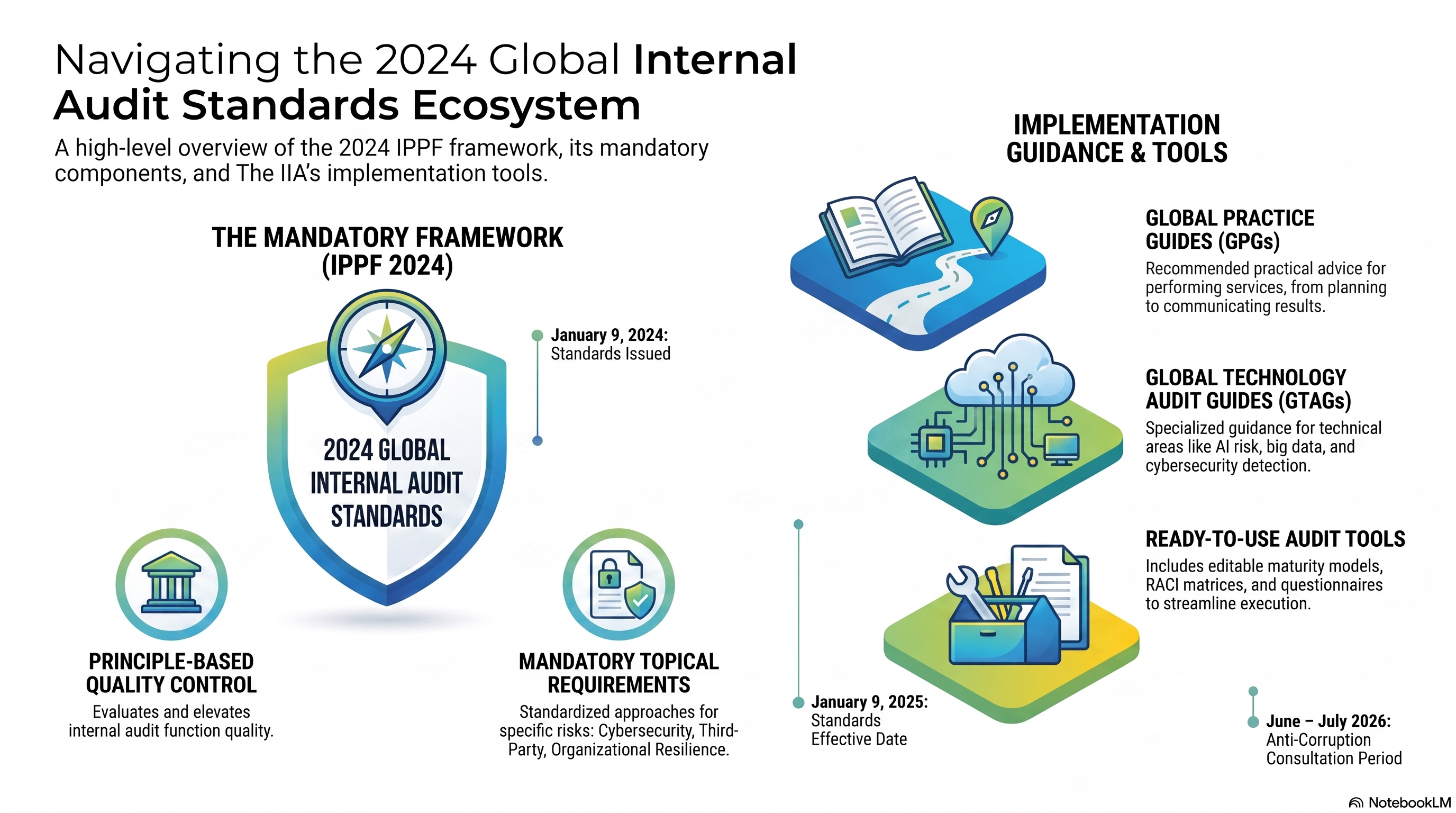
The year 2025 stands as the definitive pivot point for the profession. On January 9, 2025, the new Global Internal Audit Standards officially became effective. This 2024 Edition, known as "The Redbook™," serves as the seismic catalyst for this transformation. It marks the end of passive compliance and the birth of a dynamic, risk-responsive era in governance.
Takeaway 1: The Rise of the "Mandatory Topical"
We are witnessing the death of the "choose your own adventure" era of auditing. Historically, internal audit functions operated under broad, principle-based frameworks that offered immense flexibility—often at the cost of consistency. The new Standards introduce a counter-intuitive but necessary shift: the Topical Requirements.
This move from general principles to mandatory assessment areas ensures that critical risk domains are no longer subject to the discretion of individual audit plans. By standardizing the "how" and "what" of high-stakes assessments, the profession is establishing a rigorous, global benchmark. For instance, the Cybersecurity Topical Requirement (effective February 5, 2026) and the forthcoming requirements for Third-Party Risk represent a move toward specialized, non-negotiable rigor.
As the Redbook™ explicitly mandates:
"The Standards guide the worldwide professional practice of internal auditing, are principle-based, and serve as a basis for evaluating and elevating the quality of the internal audit function."
Takeaway 2: AI Governance Moves to the Boardroom
AI has officially graduated from a technical silo to a boardroom mandate. The release of the Board AI Governance Questionnaire and the Management AI Risk and Control Questionnaire (issued June 16, 2026) signals that AI oversight is now a fundamental pillar of corporate governance. Internal audit’s role has shifted from "observing" tech trends to providing hard assurance on how effectively management identifies, evaluates, and monitors these specific risks.
AI Coverage: A New Mandate for the Audit Committee.
The expectation is now clear: Audit Committees must be empowered with structured data on AI ethics, strategic alignment, and risk appetite. Internal audit functions that fail to provide this coverage are not just falling behind—they are leaving their boards exposed in the most volatile risk landscape of the decade.
Takeaway 3: Resilience as the New Compliance
We have moved past the era of "check-the-box" stability. The Organizational Resilience Topical Requirement (issued April 30, 2026, and effective April 30, 2027) represents a paradigm shift. It requires auditors to assess the design and implementation of governance, risk management, and control processes under extreme stress, rather than during steady-state operations.
In a visionary move, the standards now treat culture as a measurable, auditable risk. With the Organizational Behavior Topical Requirement (effective December 15, 2026), auditors must evaluate the "human" element of risk. This development acknowledges that an organization’s resilience is not found in its policy manuals, but in the behaviors and interactions of its people. This process of setting such requirements is intended to "promote confidence related to the rigor, inclusivity, and oversight" applied to the internal audit profession.
Takeaway 4: The Death of the Analog Auditor
The era of the "analog" auditor is over. The data demands of the modern enterprise have made manual sampling and retrospective testing a liability rather than an asset. To remain relevant, the internal audit function must embrace the Audit Analytics Maturity Model and the Data Analytics Skills for Internal Auditors guide.
These aren't merely "extra" tools; they are technical necessities. Expert practitioners are now utilizing the GTAG on IT Change Management (4th Edition) and Auditing Cybersecurity Operations: Prevention and Detection (2nd Edition) to bring technical weight to their findings. Modern auditors are now expected to master:
- Analytics Sophistication: Moving from descriptive statistics to predictive and prescriptive insights.
- Dynamic Data Sources: Real-time integration of internal operational data with external risk indicators.
- Data Governance: Ensuring the absolute integrity and security of the data used for real-time assurance.
Takeaway 5: The "Orange Book" and the Global Bridge
In one of the most significant moves toward global harmonization, we are seeing a unification of auditing standards across the public and private sectors. The Orange Book represents the documented alignment between The IIA’s Redbook (Global Internal Audit Standards) and the GAO’s Yellow Book (Generally Accepted Government Auditing Standards).
This represents more than just a technical mapping; it is a global bridge. For organizations operating across complex regulatory jurisdictions, this alignment reduces friction and provides a singular, unified language of risk. It ensures that whether an auditor is in a government agency or a multinational corporation, the rigor of the oversight remains consistent, promoting global confidence in the profession's ability to safeguard the public interest.
Conclusion: Beyond the Spreadsheet
The role of the Chief Audit Executive is being reimagined. In this new era, the CAE cannot merely be a historian of past failures; they must be a strategist who understands the delicate intersection of emerging technology, organizational behavior, and systemic resilience.
While the framework has undergone its most radical transformation in a decade, our core mission remains unchanged: to protect and enhance organizational value through objective assurance. In an era of mandatory AI and resilience standards, is your internal audit function a shield for the present, or a compass for the future?
No comments yet. Be the first to share your thoughts!